
Your screens are running. Your ad revenue isn't.
Conqrse SSP is the supply-side platform built for retailers with digital screens — the only in-store SSP with a CMS, brand-partner self-service, and programmatic demand built into one platform, so direct-sold deals and DSP bids run on the same priority engine instead of two stitched-together vendors.
Your brand and category managers package and sell ad space to the partners they already work with. Whatever screen time they don't sell gets filled by programmatic demand from outside brands. You control what plays. The SSP handles the rest.
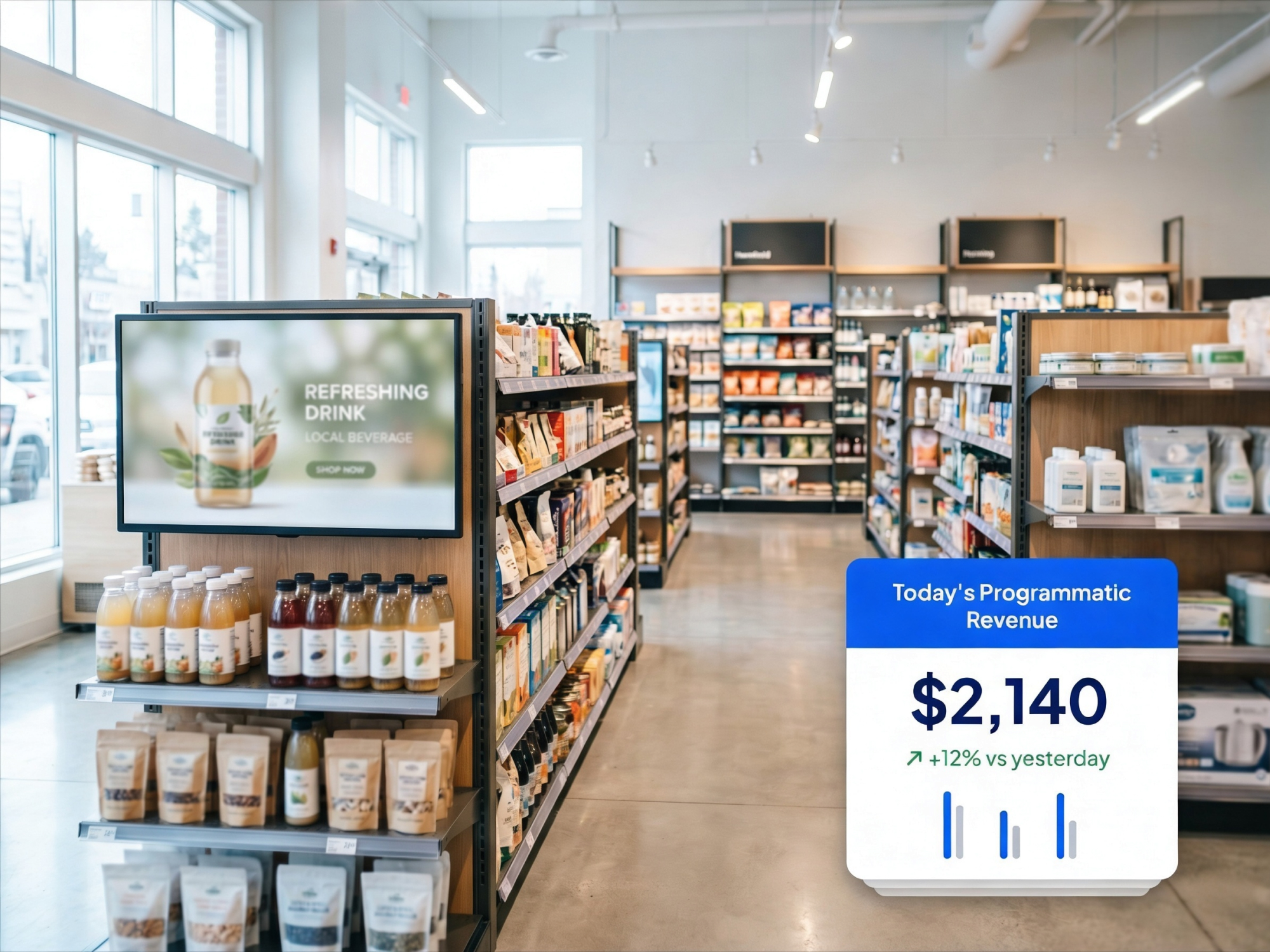
What is a supply-side platform for in-store retail media?
A supply-side platform (SSP) is software that lets a publisher — in this case, a retailer with digital screens in stores — sell ad inventory to programmatic buyers in real time. The SSP runs an auction on every available screen second, accepts bids from demand-side platforms (DSPs), and serves the winning ad to the screen. For in-store retail media, an SSP also handles direct-sold brand campaigns, prioritization rules, floor pricing, proof of play, and brand safety. It is the layer that turns a deployed screen network into a revenue channel.
Direct Sales
Your team sells ad space to brands you already know. Revenue is limited to the relationships you have today.
Ad Network
A third party connects you to a fixed pool of advertisers. You don't control pricing or brand selection.
DSP (Demand Side)
A platform advertisers use to bid on impressions. It's the other side of the auction — they buy, you sell.
SSP (Supply Side)
Software that runs a real-time auction on every screen second, connecting you to every DSP in the ecosystem simultaneously — and handles direct-sold campaigns on the same platform.
Takeaway: Direct sales captures revenue from brands you already know. An SSP captures revenue from every other brand in the world that might want to reach your shoppers. Conqrse runs both on one platform.
Your screens are deployed. Your ad revenue isn't.

The Content Treadmill
Your team creates, schedules, and manages content for every screen in every store — and none of it generates ad revenue. The screens are running, but they're a cost center, not a revenue channel.

Brands Want In. You Can't Say Yes.
Brand partners ask about advertising on your screens. Your category managers want to sell the space. But there's no system to package it, price it, book it, or report on it — so deals die in email threads.

Programmatic Sounds Like a Different Industry
Real-time bidding, DSPs, impression-level auctions — it sounds like something for websites and apps. But in-store programmatic is the fastest-growing segment in retail media, and the retailers who connect first capture the most demand.
These aren't technology problems — they're infrastructure problems. You need a platform that connects your screens to demand, handles the ad-serving stack, and lets your team focus on the relationships they already have.
How an in-store SSP turns deployed screens into revenue
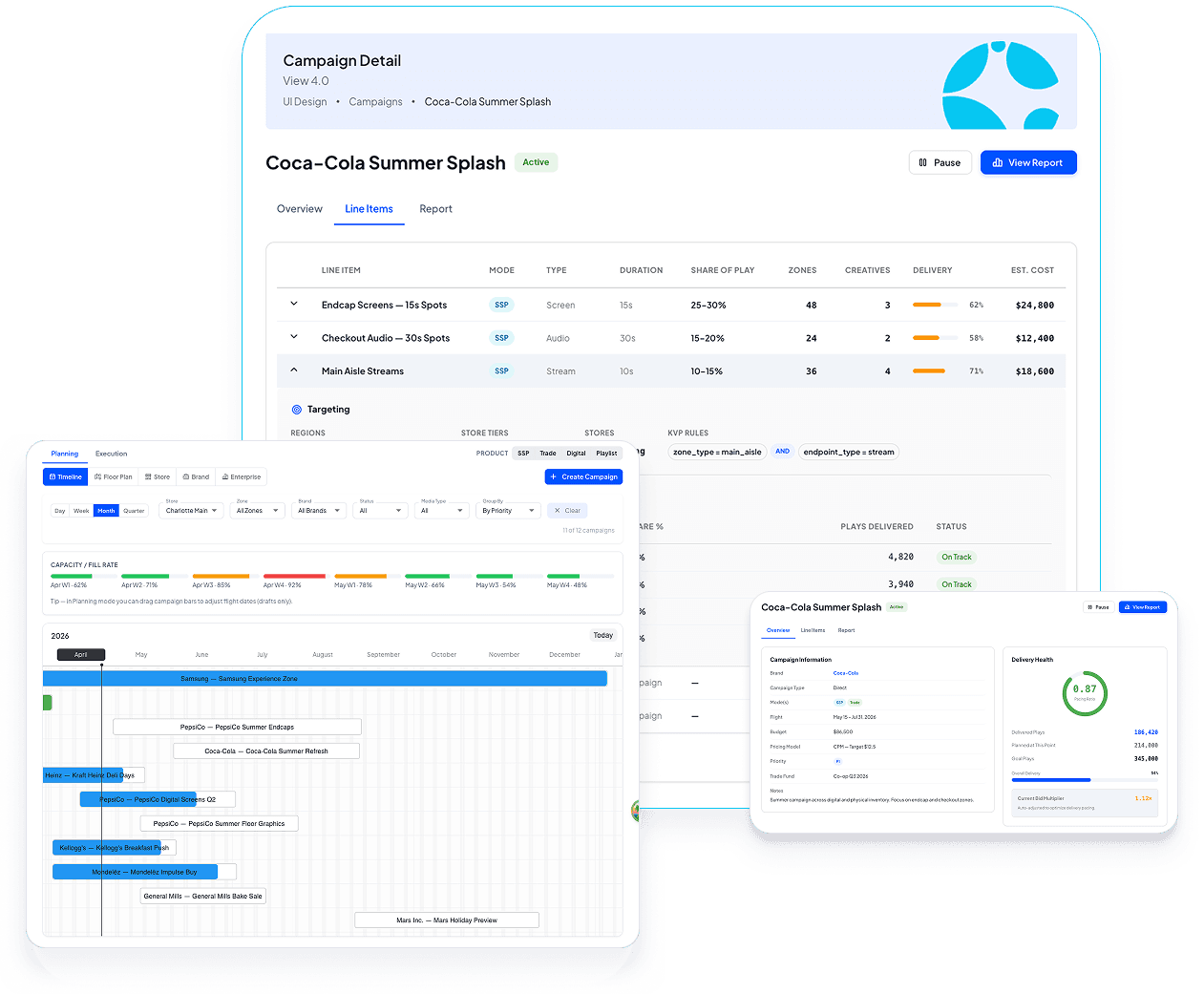
Your team packages and sells ad space to the brands you already work with.
Brand and category managers create rate cards and ad packages in the self-service portal. Brand partners browse available inventory, book campaigns, and pull proof-of-play reports — without your team in the middle of every request.
- Rate cards and ad packages your team sells to existing brand partners
- Brand partner portal where partners self-serve booking and reporting
- Proof of play reporting that backs up what you're charging
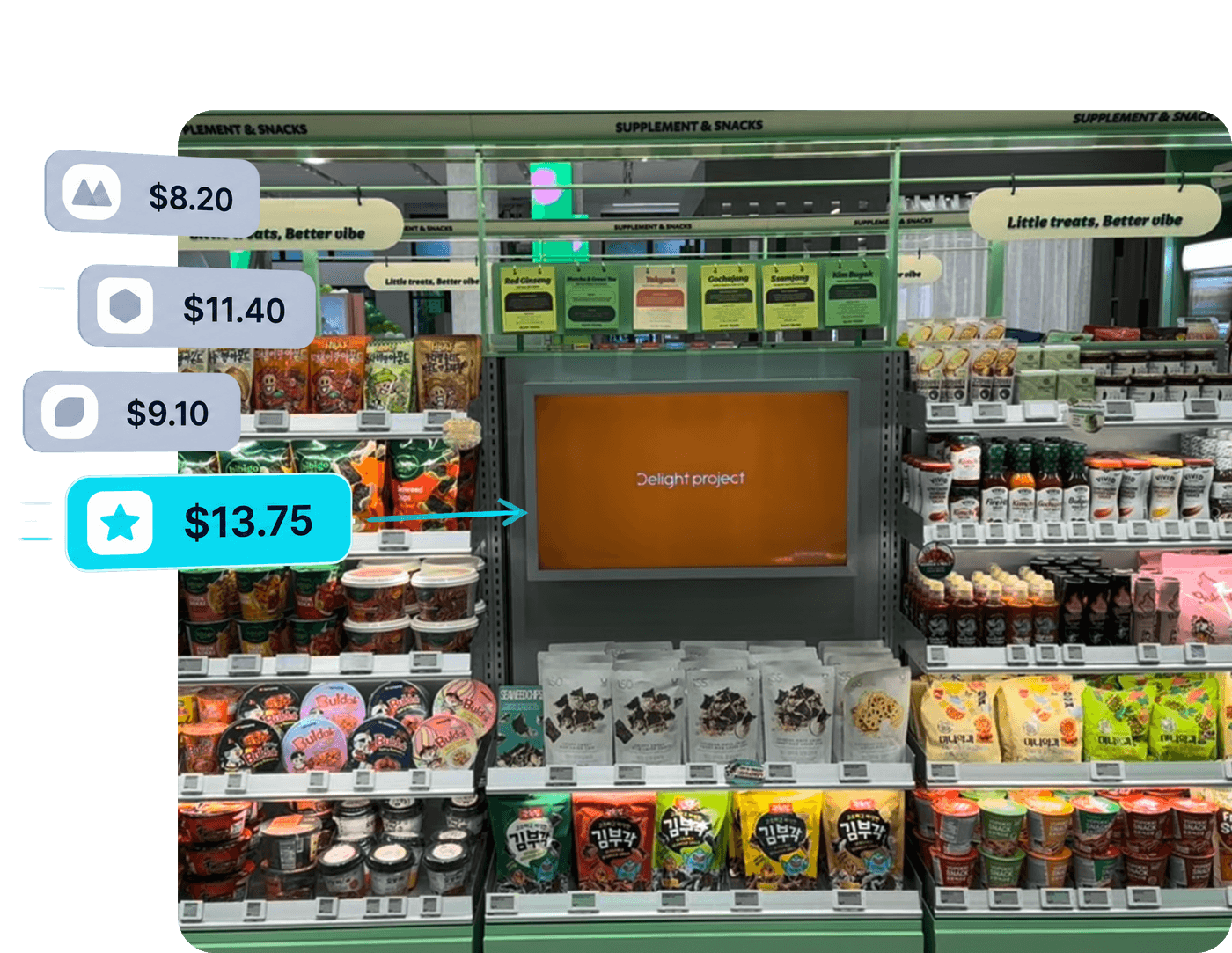
Whatever your team doesn't sell goes to a real-time auction.
Unsold screen time enters a real-time auction where demand-side platforms bid on each impression. The SSP evaluates bids, applies floor prices, and serves the winning ad — automatically, on every screen, every second.
- Real-time auction on every available screen second
- Floor pricing you control — no impressions sold below your threshold
- Brand-safety rules and category exclusions applied before any ad plays
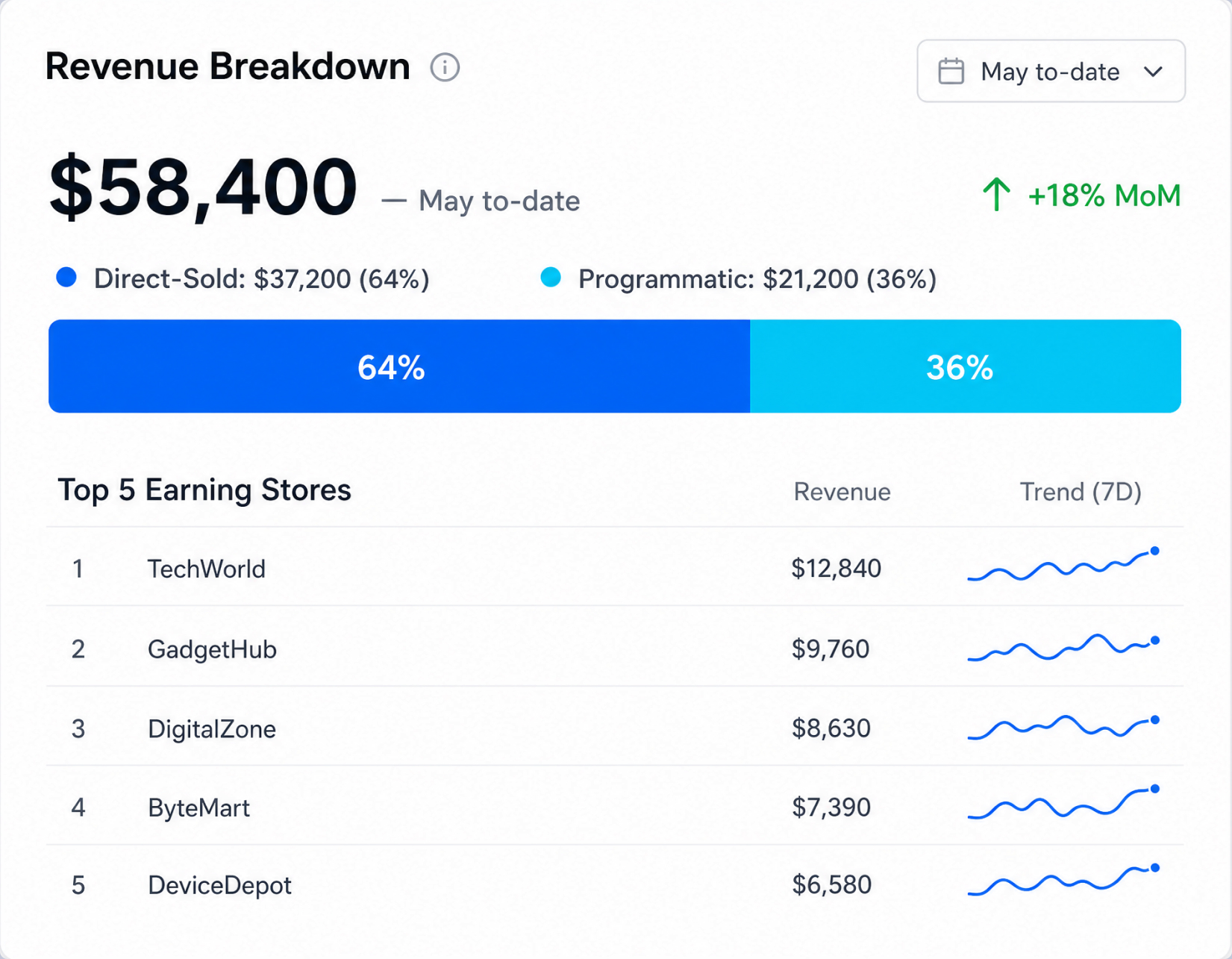
Every impression is tracked, verified, and reported in one place.
Direct-sold and programmatic revenue show up in the same dashboard. Proof of play backs every dollar. Payouts are calculated automatically — you see exactly what you keep and what the platform takes.
- Unified revenue dashboard — direct-sold and programmatic side by side
- Impression-level proof of play for both channels
- Automatic billing, reconciliation, and payout calculation
Your content comes first. Your direct deals come second. Programmatic fills the rest.
A priority waterfall is the rule set that decides which ad — retailer content, direct-sold brand campaign, or programmatic bid — wins each second of screen time. Conqrse SSP runs a four-tier waterfall on every screen, every second of operation.
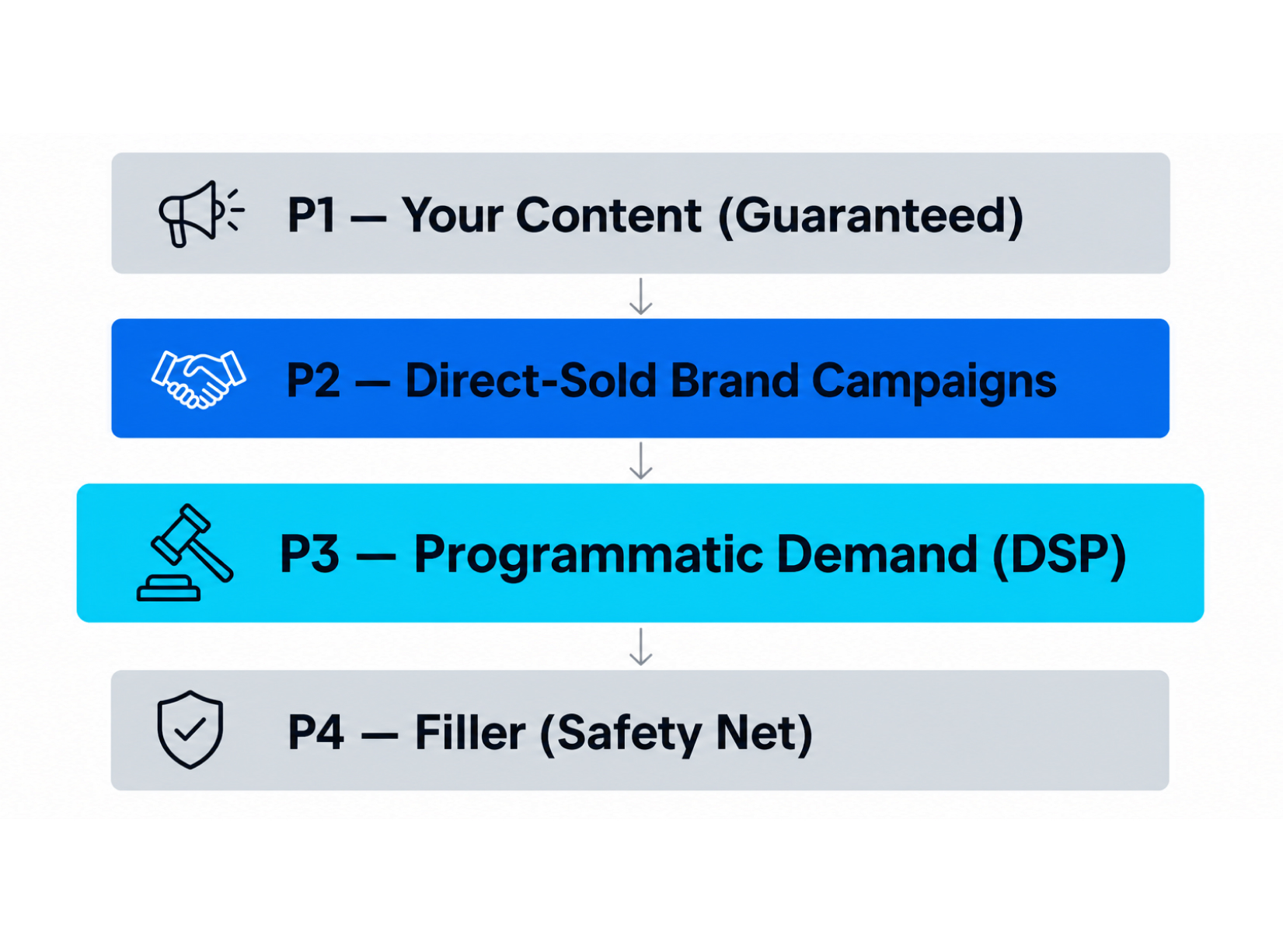
Your Content (Guaranteed)
Store announcements, wayfinding, seasonal promos. P1 content is guaranteed to play. An ad will never bump it.
Direct-Sold Brand Campaigns
Campaigns your brand and category managers sell to the partners they already work with. Runs at the rate and schedule your team sets.
Programmatic Demand (DSPs)
Real-time auction bids from demand-side platforms. Fills screen time that P1 and P2 don't claim. This is net-new revenue.
Filler (Safety Net)
Your own content runs if no ad clears the floor price. Screens are never blank. Never dead air.
You don't choose between revenue and customer experience. The waterfall handles both. Your content and direct deals always win. Programmatic fills remaining time. And if there's nothing to fill, your own content runs.
One platform, not two vendors
Most in-store SSPs are sold as a programmatic layer that bolts onto whatever CMS the retailer is already running. That means two contracts, two vendor support relationships, two roadmaps, and an integration that breaks every time either side updates. It also means there's no real way for the retailer's own brand and category managers to sell screen time directly — that has to live in a third system.
Conqrse is built differently. The CMS (Conqrse Cue), the brand-partner self-service portal, and the programmatic SSP are the same product. Direct-sold campaigns and DSP bids run on the same priority engine. Proof of play, billing, and reporting are all in one dashboard. The four-tier waterfall is a native function of the platform, not the result of two systems trying to coordinate over an API.
Typical SSP setup
(two vendors)
- ✕One contract for the CMS, one for the SSP
- ✕CMS plays scheduled content; SSP fills 'ad slots' the CMS exposes
- ✕Direct-sold campaigns live in a third system or in spreadsheets
- ✕Programmatic and direct-sold reporting in separate dashboards
- ✕Integration code maintained on both sides; breaks on updates
- ✕Blank-screen and scheduling-conflict edge cases
Conqrse setup
(one platform)
- ✓One contract
- ✓One engine decides every second of screen time
- ✓Self-service portal for direct sales is built in
- ✓One dashboard for both
- ✓No integration to break — it's one product
- ✓Native four-tier waterfall handles every edge case
Takeaway:With Conqrse, the priority waterfall isn't a feature — it's the platform. Everything else — direct sales, programmatic, content management, proof of play — is built around it.
Richer bid requests attract higher CPMs
Conqrse SSP is designed to integrate with major demand-side platforms across the in-store programmatic ecosystem. Every bid request includes a rich targeting package — not just a screen ID and a ZIP code.
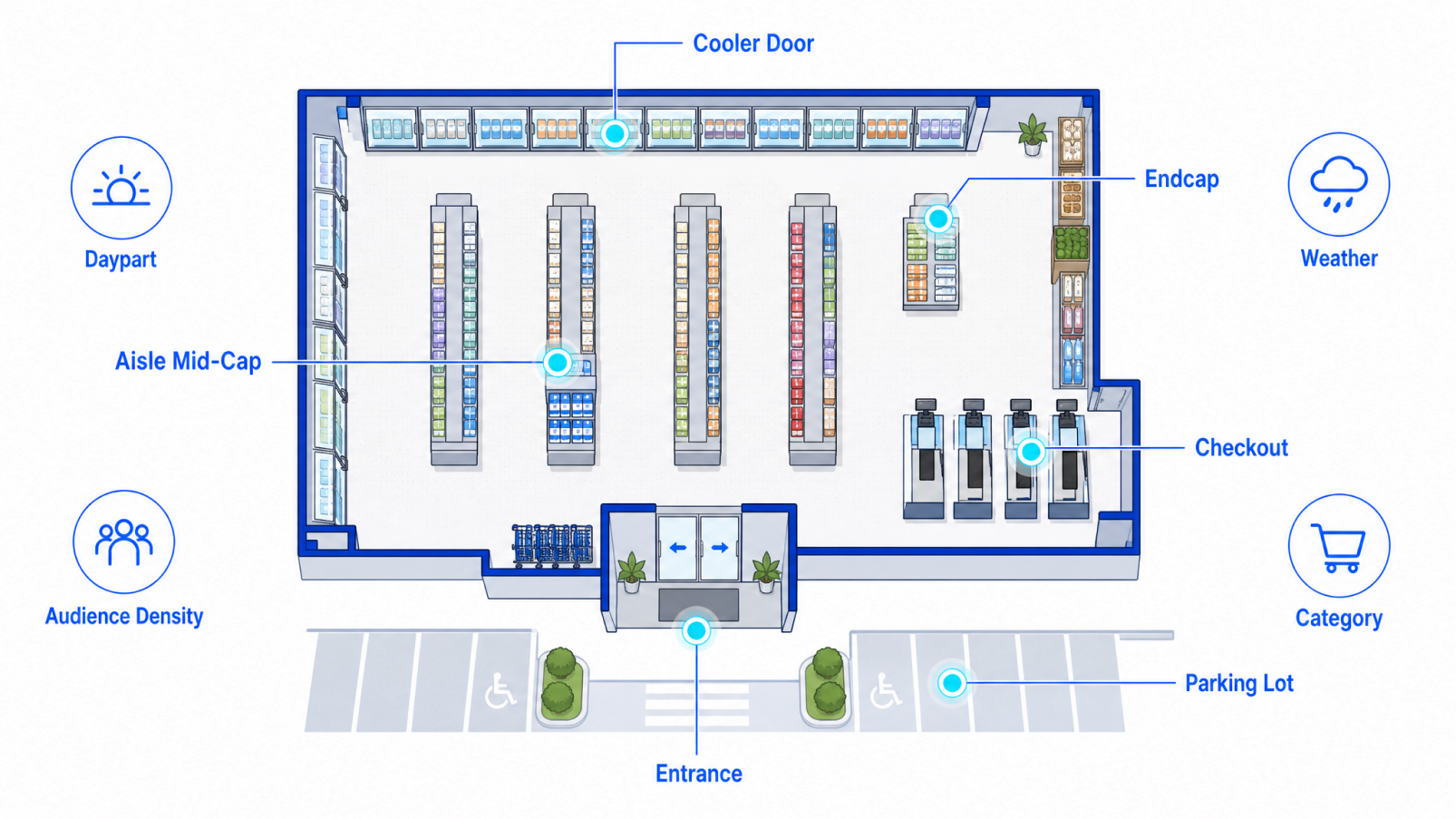
Screen Placement
Endcap, checkout, aisle-edge, entrance — DSPs bid differently based on where the screen sits.
Daypart
Morning commuter vs. evening shopper vs. weekend browser — time-of-day context shapes bid value.
Foot Traffic
Real-time and historical foot traffic signals per screen location, so DSPs know the audience size.
Dwell Time
Average time shoppers spend near each screen — higher dwell means more attention, higher CPMs.
Product Categories
Surrounding aisle and product category context — beverage, snacks, health, beauty — for contextual targeting.
Demographics
GDPR-compliant demographic signals (mixed adult, family, etc.) — aggregated, never individual.
What could your screens earn?
These are model projections — actual results vary by network size, foot traffic, placement quality, and sell-through rate. The numbers below show net new programmatic revenue only (direct-sold revenue from existing brand partners is additional).
A 15-Store Retailer with 60 Screens
A 40-Store Retailer with 200 Screens
Revenue projections based on industry CPM benchmarks for in-store programmatic ($6–$14 CPM range). Sources: eMarketer, IAB, DPAA. Individual results vary.
Why Conqrse SSP is the leading supply-side platform for in-store retail media
Conqrse SSP is the only SSP purpose-built around the actual operating reality of retailers — existing brand relationships, existing screens on existing CMSs, lean ad operations teams, and revenue that needs to show up in months. Here is what makes it the category leader.
CMS, direct sales, and programmatic in one platform — not three vendors stitched together.
Conqrse Cue (the CMS), the brand-partner self-service portal, and the programmatic SSP are the same product. The priority waterfall runs natively at the playback layer instead of across vendor APIs.
A four-tier priority waterfall that runs on every screen, every second.
Your content is always P1. Direct-sold campaigns are P2. Programmatic fills P3. Filler is the safety net at P4. You never choose between revenue and customer experience.
Brand-partner self-service portal — your partners book, manage, and report without your team in the middle.
Brand and category managers see available inventory, select packages, book campaigns, and pull proof-of-play reports through a portal your team controls.
Pure revenue-share model — no upfront cost, no per-screen fee, no monthly minimum.
Retailers keep 75–85% of gross programmatic ad revenue. The SSP earns only when you earn. No risk to try, no sunk cost if the market shifts.
Live in 4–6 weeks, no hardware changes, no content disruption.
Conqrse SSP layers onto your existing screen network and CMS. Your content keeps playing. Your team keeps operating. Revenue starts flowing.
Rich targeting packages that attract higher CPMs.
Every bid request includes placement type, daypart, foot traffic, dwell time, surrounding categories, and GDPR-compliant demographics — not just a screen ID and a ZIP code.
Proof of play at the impression level — for both direct-sold and programmatic.
Every impression is logged, verified, and reportable. Your brand partners trust the numbers. Your DSP partners get the verification they require.
One dashboard for all revenue — direct-sold and programmatic, side by side.
No toggling between two vendor portals. Revenue split, campaign performance, screen-level earnings, and payout projections in one view.
Conqrse SSP vs. other supply-side platforms
| Conqrse SSP | Vistar Media | Hivestack | Place Exchange | Generic SSP (e.g., StackAdapt) | |
|---|---|---|---|---|---|
| Built for in-store retail media | Yes — purpose-built | DOOH-first, in-store secondary | DOOH-first, in-store secondary | DOOH-first | No — web/app focus |
| Built-in CMS (content management) | Yes — Conqrse Cue | No — requires third-party CMS | No — requires third-party CMS | No | No |
| Brand-partner self-service portal | Yes — built in | No | No | No | No |
| Direct-sold + programmatic on one engine | Yes — single priority waterfall | Limited — separate workflows | Limited — separate workflows | Programmatic only | Programmatic only |
| Four-tier priority waterfall | Yes — native | No | No | No | No |
| Proof of play (impression-level) | Yes — both channels | Yes — programmatic | Yes — programmatic | Yes — programmatic | Limited |
| Rich targeting signals (placement, daypart, dwell, categories) | Yes | Partial — venue-level | Partial — venue-level | Limited | No — web-native signals |
| Revenue-share pricing (no upfront cost) | Yes — 15–25% rev share | Varies | Varies | Varies | No — SaaS fee |
| Go-live in 4–6 weeks, no hardware changes | Yes | Longer — CMS integration required | Longer — CMS integration required | Varies | N/A |
| Unified revenue dashboard | Yes — direct + programmatic | Programmatic only | Programmatic only | Programmatic only | No |
| Designed for retailers (not DOOH operators) | Yes — retailer-first | DOOH operator-first | DOOH operator-first | DOOH operator-first | No |
Designed to integrate with any standards-compliant CMS
Conqrse SSP is designed to integrate with any standards-compliant content management system through VAST/VPAID-based ad serving. If you already run a CMS, the SSP slots in as an ad-serving layer without replacing your content stack. If you're starting from scratch, Conqrse Cue is built around the SSP from day one.
Conqrse SSP integrates with any standards-compliant CMS through VAST/VPAID-based ad serving.
Conqrse Cue
The digital signage CMS built around the SSP from day one. If you're starting fresh or want the tightest integration, Cue is the native path.
Learn about CueConqrse Trade
Turn your existing brand partner programs into a structured, measurable media product. Trade and SSP work together — direct-sold through Trade, programmatic through the SSP.
Learn about TradeYou see the revenue. We manage the infrastructure.
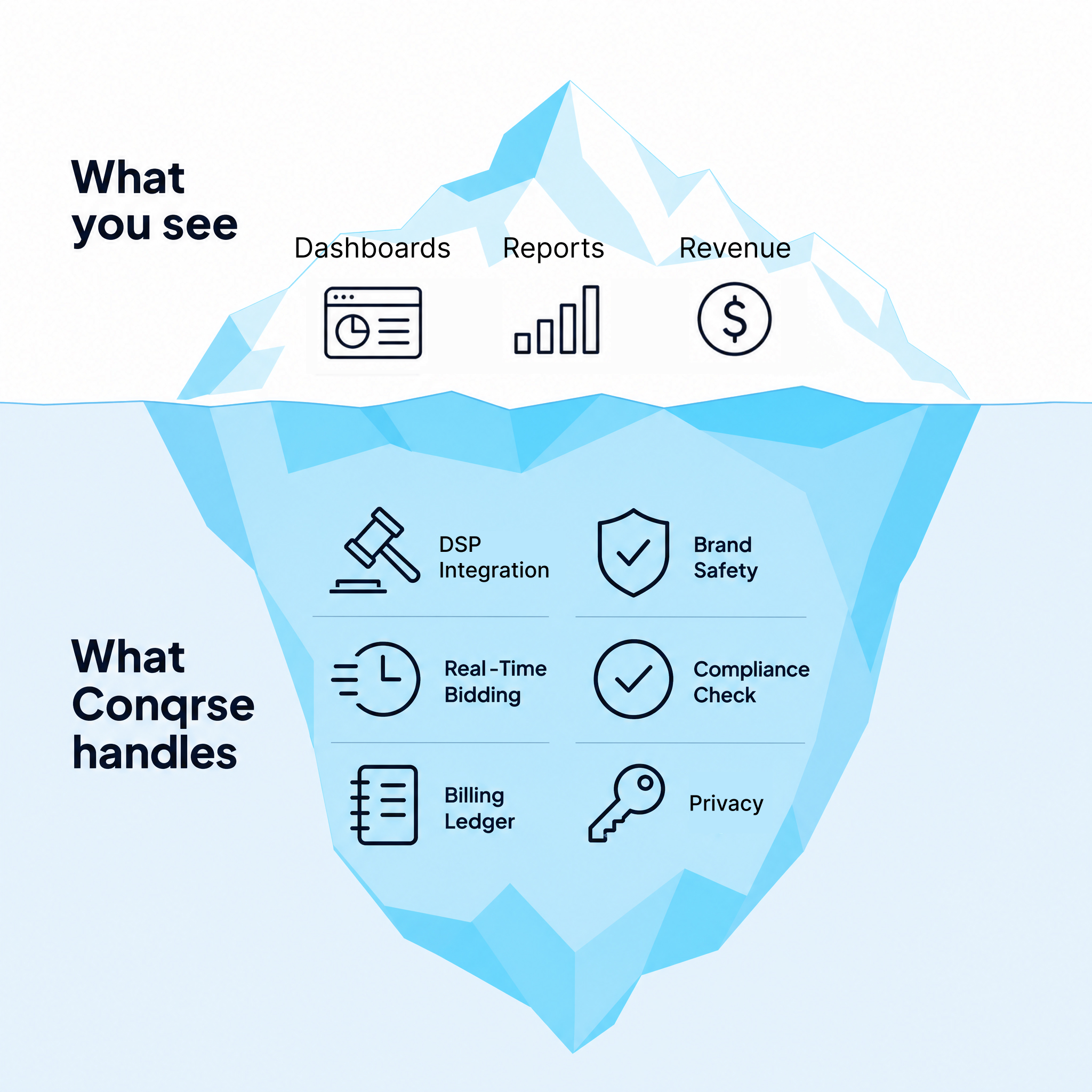
What You See
- Revenue dashboard.
- One view of all ad revenue — direct-sold and programmatic, by screen, by store, by campaign.
- Per-screen earnings.
- See exactly how much each screen earns, so you know which placements are most valuable.
- Campaign reports.
- Proof of play, impressions, CPM, and revenue for every campaign — exportable for brand partners.
- Payout summary.
- Clear revenue-share breakdown so you always know what you keep and what the platform takes.
What We Manage
- DSP integration framework.
- Conqrse SSP is designed to integrate with major demand-side platforms across the in-store programmatic ecosystem, so retailers don't have to negotiate, contract with, or technically integrate with each DSP separately as the market expands.
- Real-time bidding engine.
- Auction logic that runs on every screen second — evaluating bids, applying floor prices, and selecting the winning ad in milliseconds.
- Ad quality and brand safety.
- Category exclusions, creative review, and brand-safety rules applied at the platform level before any ad reaches a screen.
- Impression verification.
- Proof-of-play logging at the impression level — every ad on every screen is verified and reportable.
- Floor price optimization.
- Dynamic floor pricing that adapts to demand, daypart, and placement to maximize revenue without leaving money on the table.
- Fill-rate management.
- Automatic fallback logic that ensures screens are never blank — filler content plays if no bid clears.
- Billing and reconciliation.
- DSP invoicing, retailer payouts, and revenue reconciliation handled end to end.
- Privacy compliance.
- GDPR and privacy-compliant targeting signals — aggregated, never individual. No PII in bid requests.
- Reporting infrastructure.
- The data pipeline that powers dashboards, proof of play, and partner-facing reports — maintained and scaled by the platform.
The in-store programmatic market is early — and growing fast
Projected in-store programmatic ad spend by 2028
eMarketer / IABCAGR for in-store retail media through 2027
DPAA / GroupMof retailers say in-store media is a top-3 priority
IABaverage CPM for premium in-store screen placements
Industry benchmarkaverage dwell time at endcap screens
In-store analytics datahigher attention than digital OOH billboards
DPAA studyof revenue retained by the retailer on Conqrse SSP
Conqrse revenue-share termsIn-store retail media is where online display was in 2012 — early, fragmented, and about to scale. The retailers who connect their screens to programmatic demand now will capture the most value as DSPs expand into physical environments.
Common questions about in-store SSPs and Conqrse
What is a supply-side platform (SSP)?
A supply-side platform is software that helps a publisher sell ad inventory to programmatic buyers in real time. For in-store retail media, an SSP runs an auction on every available screen second, accepts bids from demand-side platforms, and serves the winning ad to the screen — while also managing direct-sold brand campaigns, prioritization, floor pricing, and proof of play.
What does an SSP do for a retailer with digital screens?
An SSP turns a deployed screen network into a revenue channel. It manages the entire ad-serving stack: direct-sold brand campaigns your team sells, programmatic bids from outside brands via demand-side platforms, priority rules that protect your own content, floor pricing, proof of play, and billing — so the retailer captures ad revenue from every available screen second without building the infrastructure themselves.
How is an SSP different from a CMS or ad network?
A CMS schedules and plays content on screens. An ad network connects a publisher to a fixed pool of advertisers. An SSP runs a real-time auction on every available impression, connecting the publisher to every demand-side platform in the ecosystem simultaneously — and handles direct-sold campaigns, priority rules, and reporting in the same platform.
How does Conqrse SSP work?
Conqrse SSP works in three steps: Sell — your brand and category managers package and sell ad space to the partners they already work with through a self-service portal. Fill — whatever screen time they don't sell goes to a real-time auction where demand-side platforms bid on each impression. Earn — every impression is tracked, verified, and reported in one dashboard, with revenue split visible in real time.
What is a priority waterfall?
A priority waterfall is the rule set that decides which ad — retailer content, direct-sold brand campaign, or programmatic bid — wins each second of screen time. Conqrse SSP runs a four-tier waterfall: P1 is the retailer's own content (always guaranteed), P2 is direct-sold brand campaigns, P3 is programmatic demand from DSPs, and P4 is filler content as a safety net.
How much revenue can a retailer earn from in-store programmatic?
Revenue depends on screen count, foot traffic, placement quality, and sell-through rate. A 15-store retailer with 60 screens might generate $8,000–$25,000 per month in net new programmatic revenue. A 40-store retailer with 200 screens could see $30,000–$90,000 per month. These are model projections — actual results vary by network.
What does Conqrse SSP cost?
Conqrse SSP operates on a pure revenue-share model. There is no upfront cost, no monthly minimum, and no per-screen fee. Retailers keep 75–85% of gross programmatic ad revenue. The revenue share covers the full SSP stack: ad serving, auction management, DSP integrations, proof of play, billing, and reporting.
Which DSPs does Conqrse SSP connect to?
Conqrse SSP is designed to integrate with the major demand-side platforms buying in-store programmatic inventory. As the in-store programmatic ecosystem matures, the SSP adds new DSP partnerships so retailers don't have to negotiate, contract with, or technically integrate with each one separately.
Do I need to replace my existing CMS?
No. Conqrse SSP is designed to integrate with any standards-compliant content management system through VAST/VPAID-based ad serving. If you already run a CMS, the SSP slots in as an ad-serving layer without replacing your content stack. If you're starting from scratch, Conqrse Cue is built around the SSP from day one.
How long does it take to go live?
Most retailers are live on Conqrse SSP within 4–6 weeks. The platform does not require hardware changes or content disruption — it layers onto your existing screen network and CMS.
How is Conqrse SSP different from Vistar Media or Hivestack?
Vistar Media and Hivestack are DOOH-first SSPs built primarily for billboards, transit, and large-format digital out-of-home. In-store retail screens are a secondary use case. Conqrse SSP is purpose-built for in-store retail media: it includes a CMS (Conqrse Cue), a brand-partner self-service portal, and a four-tier priority waterfall that handles direct-sold and programmatic demand natively — without requiring a separate CMS vendor or booking tool.
What is proof of play?
Proof of play is a verified record that a specific ad was displayed on a specific screen at a specific time. Conqrse SSP logs every impression at the screen level and provides proof-of-play reporting for both direct-sold and programmatic campaigns — backing up what you charge brand partners and what DSPs are billed.
What data does Conqrse SSP send to DSPs?
Conqrse SSP sends a rich targeting package with each bid request: screen placement type, daypart, foot traffic signals, dwell time, surrounding product categories, and GDPR-compliant demographic signals. Richer bid requests attract higher CPMs because DSPs can target more precisely.
Does the retailer control what plays on their screens?
Yes. The priority waterfall guarantees that retailer content (P1) always plays first. Direct-sold brand campaigns (P2) come second. Programmatic demand (P3) only fills time that isn't claimed by P1 or P2. The retailer sets floor prices, brand-safety rules, and category exclusions.
What is in-store retail media?
In-store retail media is advertising displayed on digital screens inside physical retail stores. It includes endcap displays, checkout screens, aisle-edge screens, and entrance/exit signage. Retailers monetize these screens by selling ad space to brand partners directly and by connecting to programmatic demand through a supply-side platform.
What is programmatic advertising in a physical store?
Programmatic advertising in a physical store uses automated, real-time auctions to sell ad impressions on in-store digital screens to the highest bidder — the same way programmatic works on websites and apps, but applied to physical retail environments. An SSP runs the auction; DSPs place bids on behalf of advertisers.
How does Conqrse SSP handle billing and payouts?
Conqrse SSP handles all billing infrastructure: impression verification, revenue reconciliation, DSP invoicing, and retailer payouts. The retailer sees a single revenue dashboard with direct-sold and programmatic revenue split in real time. Payouts are net of the agreed revenue-share percentage.
See what your screens could earn
Send us your details and we'll build a custom revenue model for your screen network. Or book a call to walk through it live.
Book a Revenue Call
Walk through the revenue model live with our team. 15 minutes. No pitch deck — just your numbers.
About Conqrse SSP
Conqrse SSP is the supply-side platform built for retailers running digital screens in physical stores. Operated by Conqrse, the in-store retail media platform headquartered in Charlotte, North Carolina, the SSP is the only in-store SSP with the CMS (Conqrse Cue), the brand-partner self-service portal, and the programmatic ad engine combined into one product — running direct-sold campaigns and programmatic bids on a single four-tier priority waterfall. Conqrse SSP is designed to integrate with any standards-compliant content management system as a standalone ad-serving layer, and is built to work with major demand-side platforms across the in-store programmatic ecosystem. The platform operates on a pure revenue-share model with no upfront cost — retailers running Conqrse SSP keep 75–85% of gross programmatic ad revenue.